Lumière Hair Clinic · Hair loss
Male pattern hair loss
Recession and crown thinning, treated as the medical issue it is.

The Procedural Physician
Dr Kristy Truong
US fellowship-trained
AHPRA MED0002351485
Hair assessment with Dr Kristy Truong — 45 minutes, $250, redeemable against treatment within 30 days.
- Doctor-run · A physician assesses you first
- Diagnosis first
- Inside a medical centre · Discreet by design
Prefer to talk first?
Request a callback — we'll call you within one business day.
Or call 08 6388 4474·Book online →
Who to see
The Procedural Physician
Dr Kristy Truong
Advanced Aesthetic Procedures & Hair Transplants
Dr Kristy Truong leads the clinical practice at Lumière.
View profileWhat can realistically be done
Doctor-run diagnosis
Confirm it is pattern loss and not something else — thyroid, iron, autoimmune — before treating.
Prescription therapy
Where appropriate, prescribed and monitored properly — priced in consultation.
Regenerative scalp treatment
Supports follicle health, delivered as a course by a doctor.
Transplant planning
Where transplantation is genuinely worth considering, planned and performed by Dr Truong — the last step in the sequence, never the first.
What can't
Treatment maintains and thickens; it does not regrow a bare scalp. Products alone rarely change the trajectory. And stopping treatment means losing ground — we tell you that before you start.
What's going on
Male pattern loss is hormonal and genetic: follicles miniaturise under the influence of DHT, gradually and then noticeably. It is the most common thing men ask us about, and the most poorly served by the product industry.
The key fact is timing: treatments preserve and thicken best where follicles still live. Earlier is genuinely better — which is why the assessment matters more than any product.
Why it happens
- Genetic sensitivity to DHT
- Age — progressive without treatment
- Family pattern is a strong guide
- Sometimes compounded by health or medication factors
The Norwood scale
The Norwood stages, in plain language
Doctors grade male pattern loss on the Norwood scale, from I to VII. The stage matters less as a label than for what it changes: which treatments still work, how much donor hair a plan can spend, and whether the pattern has finished declaring itself.
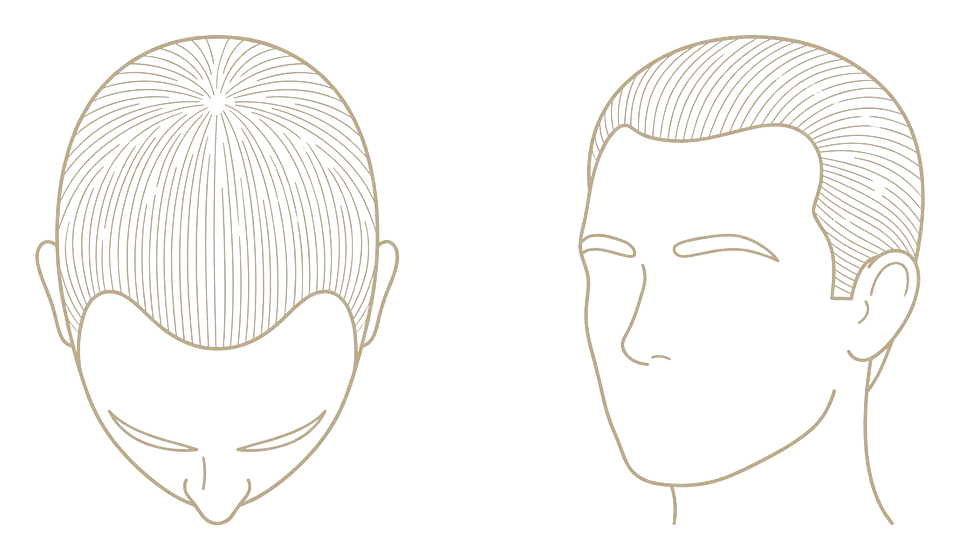 I
No visible loss
A juvenile or mature hairline with no recession. Nothing to treat.
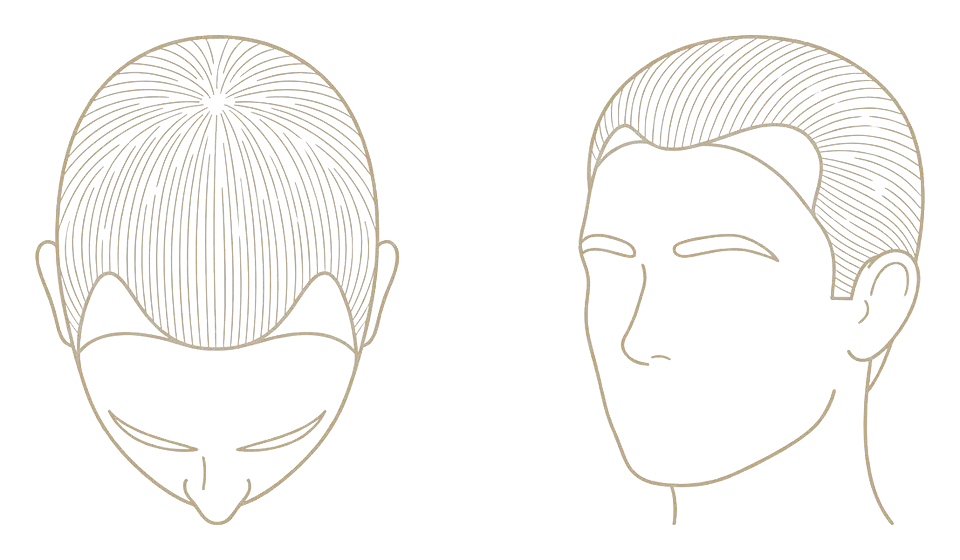 II
Mature hairline
Slight recession at the temples. Many men stay here for life; it is not, on its own, a reason to act.
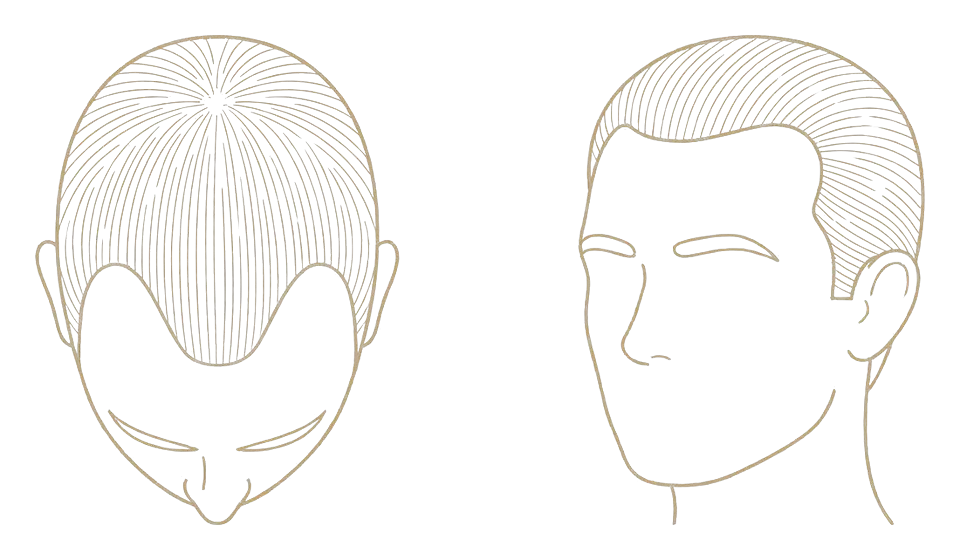 III
First real recession
Deeper temple recession, sometimes with early crown thinning (III vertex). The earliest stage at which treatment is usually worth discussing — and the stage where medicine does the most.
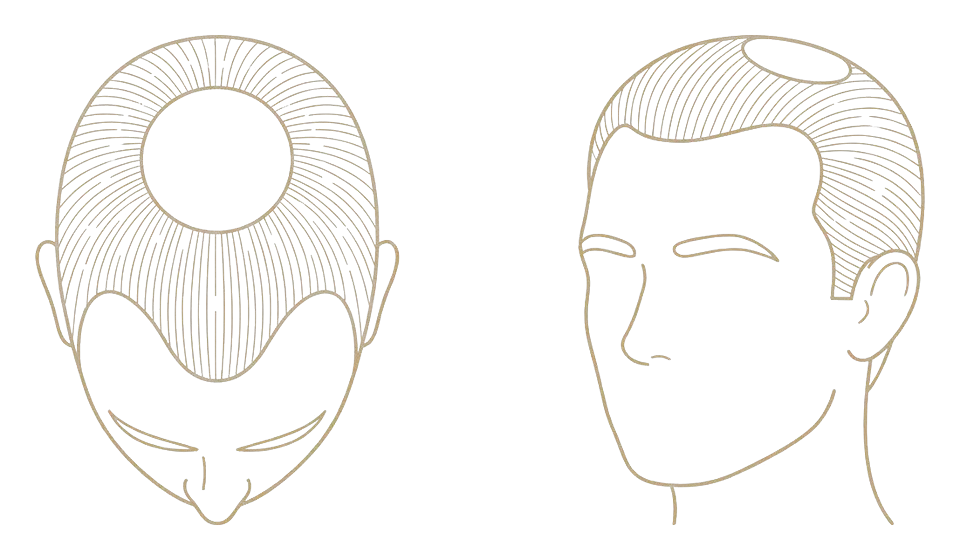 IV
Recession and crown
Recession deepens and the crown thins, with a band of hair still separating the two areas. Medical treatment still matters; transplant planning becomes a genuine conversation when loss is stable.
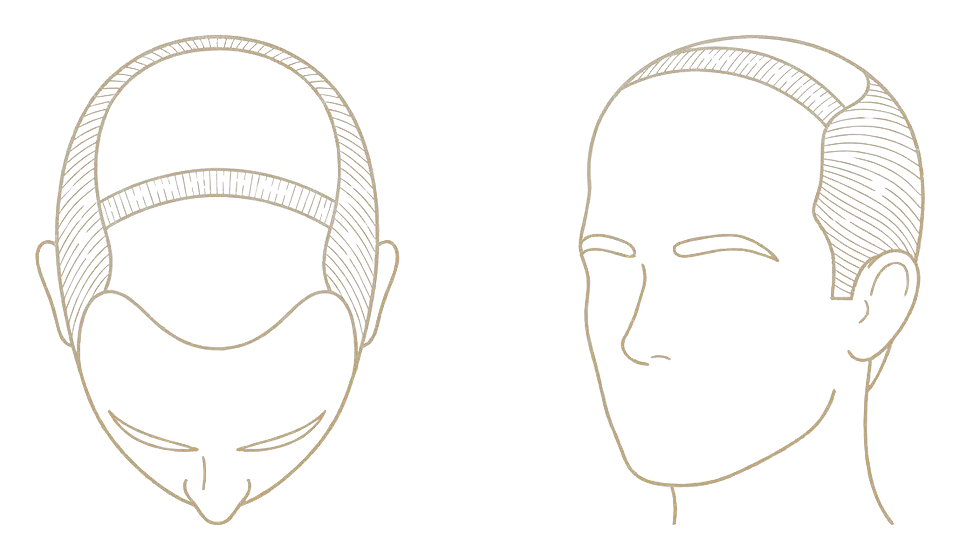 V
The band narrows
The bridge between front and crown thins. Coverage, rather than density, is the honest planning goal.
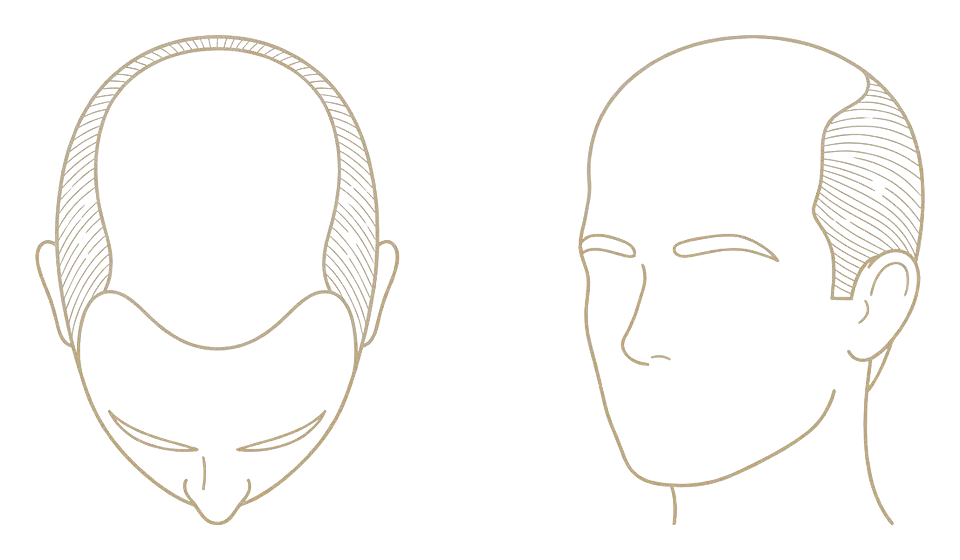 VI
Front and crown join
The bridge is gone. Donor supply, not ambition, sets what a transplant can achieve.
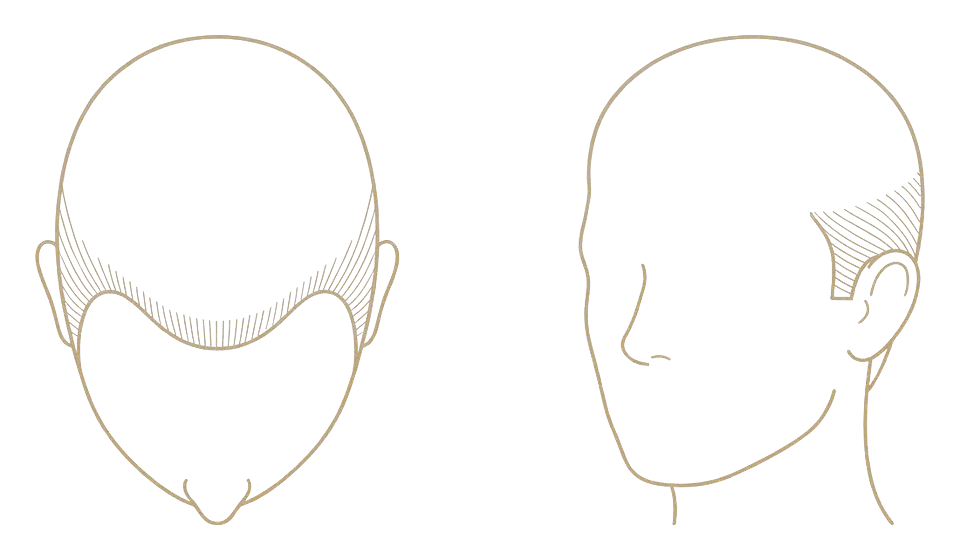 VII
Advanced loss
A narrow horseshoe of hair remains at the back and sides. Transplantation is rarely the right answer; we say so.
Illustrations are schematic and show the typical pattern at each stage. Your own pattern, and how quickly it is changing, are assessed in person.
Why the stage changes the answer
At stage II or III, most follicles are miniaturising rather than gone — which is exactly the situation prescription treatment is good at. Started then, medicine preserves the hair you have for years, and a transplant may never be needed.
By stage V or VI, the question is different: how much permanent donor hair exists at the back and sides, and how to spend it for the most impression. The answer is coverage and framing, planned honestly, not a return to a stage-I head of hair.
In sequence
Three pathways, in sequence
Medical treatment
Prescription therapy to slow or stabilise active loss, prescribed and monitored by a doctor. Priced in consultation, as regulation requires.
PRP and PRF
Your own platelets returned to the scalp to support follicles that are thinning but alive. A course, then maintenance.
Transplantation
For stable loss with adequate donor supply — hairline designed by hand, performed by Dr Truong, reviewed by her in person.
When to treat, and when to wait
Treat early where loss is active — preserving hair is far easier than replacing it. Wait on anything permanent while the pattern is still declaring itself, which for many men means the twenties. Waiting is not doing nothing: medical treatment through those years protects the hair you have, and the transplant conversation, if it comes, is a better one.
What a first visit involves
- Your history and what's bothering you, in your words
- An examination and an honest plan, with costs in writing
- No treatment at a first visit
Hair assessment with Dr Kristy Truong — 45 minutes, $250, redeemable against treatment within 30 days.
What to expectQuestions
Where to go next
Considering treatment? Start with a hair assessment — diagnosis first, then the right treatment, which is not always a transplant. Book an assessment
Book an assessment
Diagnosis first. Then the right treatment — which is not always a transplant.